Marketing Monday is back!
Please welcome Gail Gauthier, author of eight children's books, including The Hero of Ticonderoga, an ALA Notable Book, and the Hannah and Brandon Stories series. Gail just re-released her book Saving the Planet & Stuff, this time as an eBook. She's here to share what it's like to go through the eBook marketing process with a book that was originally released in hardback.
So without further ado ... welcome, Gail!
Saving the Planet & Stuff first appeared in 2003 as a hardcover book traditionally published by G. P. Putnam’s Sons and marketed for grades 5 and up. This year it has been re-released as a self-published eBook marketed for YA and up.
Back in 2003, my marketing efforts were pretty much limited to the website and blog I was already maintaining and a few press releases that I sent out to publications in Connecticut, where I lived, and Vermont, where the book was set. The bulk of the marketing was done by my publisher, while I worked on my next book.
I am the publisher of the eBook, so this time I’ll be doing all the marketing. Ten years have passed and my platform is a little more extensive, anyway. In addition to the website and blog, I have a professional as well as personal Facebook page, an author page at Amazon, and I’m active on Goodreads, where I have a second blog.
Beyond that, my marketing plan has been developed around the fact that Saving the Planet & Stuff is now an eBook.
The first marketing task was acquiring a new cover, which was created by Eric Bloom. This eBook cover carries a little more weight than the covers of my traditionally published books did. For one thing, it includes the tag line “An Eco-Comedy” because I wanted to make sure potential readers knew that this book is funny.
In addition, you’ll see “Gail Gauthier Author of Happy Kid!” printed at the bottom of the image. It’s not unusual to see an author’s earlier work noted on the cover of a traditionally published book. The reference to the earlier book could help sell the new one.
With eBooks, it’s supposed to work the other way, too. If readers like the new eBook they’ve just read, it’s possible they’ll buy another eBook by the same author, assuming they know it’s available. That explains why Happy Kid! is on the eBook cover of Saving the Planet & Stuff instead of my ALA Notable book, The Hero of Ticonderoga. G. P. Putnam’s Sons has published an eBook edition of Happy Kid! while Hero is out-of-print. With my new Saving the Planet cover, I’m trying to market two books, Saving the Planet, of course, and Happy Kid!.
I understand readers moving from one eBook to another because I’m an eBook reader myself. I’ve been known to finish reading one eBook and buy another in the same series in the middle of the night while I’m in bed. My own eBook purchasing habits have shaped another aspect of my marketing of Saving the Planet & Stuff. With an eBook, you don’t have to wait to go to a bookstore to purchase it. You don’t have to pick up the phone and order it from a store or go on-line to do so. You don’t have to wait for the book to arrive in the mail. You can order the book from your e-reader and be reading it seconds later. I wanted that kind of availability for anyone who saw or read anything about Saving the Planet & Stuff.
While I have been talking about this publishing project at my blog, website, and Facebook pages, I waited until the eBook had actually published before posting the book trailer to YouTube or approaching many bloggers to request reviews or guest posts.
I didn’t want people to see a trailer or early review and not be able to buy the book right at that minute. I’m making the assumption that other eBook readers shop the way I do.
I’m also considering doing some paid advertising through Amazon at some point. Because Saving the Planet & Stuff is an eBook, I don’t have to worry about making big sales right out of the gate in order to keep a traditional paper and print book on store shelves.
This whole project is an experiment for me. At this point, the experiment is going to involve approaching bloggers and continuing with on-line marketing for quite some time, instead of putting everything up front, at time of publication.
Thanks so much for the glimpse into the marketing differences between traditional and e-publishing, Gail! Best of luck with your marketing efforts. Saving the Planet & Stuff looks like a lot of fun--can't wait to read it!
* * *
Gail Gauthier is the author of eight children's books, including The Hero of
Ticonderoga, an ALA Notable Book, and the two volumes of the Hannah and Brandon
Stories series, A Girl, a Boy, and a Monster Cat, and A Girl, a Boy, and
Three Robbers, which were both selected as Junior Library Guild offerings. Her books
have been nominated for readers' choice awards in six states, and published in foreign
editions in Italy, Germany, France, and Japan. She has spoken in schools in Connecticut,
Massachusetts, and Vermont, as well as at professional conferences. She maintains the
weblog Original Content, where she writes about children's literature, writing,
and time management for writers.
Showing posts with label children's books. Show all posts
Monday, March 4, 2013
Marketing Monday - Gail Gauthier
Labels:
author,
blog tour,
book release,
children's books,
fiction,
Marketing Monday,
YA
Thursday, September 27, 2012
Nurturing curiosity
Last weekend, I attended the Rocky Mountain SCBWI conference in Denver. It was a terrific meeting (such an enthusiastic, involved group!), and I had the opportunity to talk with agent Karen Grencik of Red Fox Literary, and editors Emily Clement of Arthur A. Levine Books and Sylvie Frank of Holiday House--gracious women, every one.
As a non-fiction writer, I paid close attention when the Common Core State Standards came up. Both Karen and Sylvie mentioned the importance of tying books to the Common Core. If a story has the potential to be used in the classroom, it will be much more likely to get published.
More and more, teachers are looking for books that allow them to "teach smarter, not harder," as a principal at a nearby school so eloquently put it. What does that mean? Teachers need books that teach literacy while providing curriculum-related content. Books that kill two birds with one stone, if you will.
(As an aside: If you teach science, Melissa Stewart has a terrific Pinterest board to help you find books to fit some of the Common Core standards.)
Teachers need to find ways to teach math and science simultaneously. Science and math are closely connected, and yet I get the sense that they're typically taught as completely distinct subjects. Do they have to be? Can't we interweave them, thereby increasing the amount of time available to dedicate to both?
For example, in a life cycles unit a class may order caterpillars. Watching them pupate and emerge as adult butterflies is a remarkable experience, but it can be so much more.
Order caterpillars that are smaller, those that have more time to grow. Then have the students measure them. Weigh them. Graph the change in size over time. Weigh plant material before it's given to the butterflies, then again a day later. How much weight was lost? Was the same amount gained by the caterpillars? Why or why not? If the plants lost more weight than the caterpillars gained, where could the rest have gone?
Think you don't have enough science time to extend the life cycles unit? That's the beauty of "teaching smarter"--you can squeeze science into the daily math routine. And numbers are so much more interesting when they mean something.
I think--or rather hope--that the Common Core will encourage just this kind of cross-over in the classroom. After meeting with the principal mentioned above, and one of the teachers at her school, I strongly believe that we can again foster a love of science--and math--by returning to a hands-on approach and blurring the lines between subjects.
Math is fun and cool when it has real-life application. And science is all about curiosity--after all, what is a scientist but a kid who never stopped asking "Why?"
The possibilities for exploration and discovery, critical thinking and inquiry-based learning are endless if we can just start to see the curriculum in a new way.
As a non-fiction writer, I paid close attention when the Common Core State Standards came up. Both Karen and Sylvie mentioned the importance of tying books to the Common Core. If a story has the potential to be used in the classroom, it will be much more likely to get published.
More and more, teachers are looking for books that allow them to "teach smarter, not harder," as a principal at a nearby school so eloquently put it. What does that mean? Teachers need books that teach literacy while providing curriculum-related content. Books that kill two birds with one stone, if you will.
(As an aside: If you teach science, Melissa Stewart has a terrific Pinterest board to help you find books to fit some of the Common Core standards.)
Teachers need to find ways to teach math and science simultaneously. Science and math are closely connected, and yet I get the sense that they're typically taught as completely distinct subjects. Do they have to be? Can't we interweave them, thereby increasing the amount of time available to dedicate to both?
For example, in a life cycles unit a class may order caterpillars. Watching them pupate and emerge as adult butterflies is a remarkable experience, but it can be so much more.
| source |
Order caterpillars that are smaller, those that have more time to grow. Then have the students measure them. Weigh them. Graph the change in size over time. Weigh plant material before it's given to the butterflies, then again a day later. How much weight was lost? Was the same amount gained by the caterpillars? Why or why not? If the plants lost more weight than the caterpillars gained, where could the rest have gone?
Think you don't have enough science time to extend the life cycles unit? That's the beauty of "teaching smarter"--you can squeeze science into the daily math routine. And numbers are so much more interesting when they mean something.
I think--or rather hope--that the Common Core will encourage just this kind of cross-over in the classroom. After meeting with the principal mentioned above, and one of the teachers at her school, I strongly believe that we can again foster a love of science--and math--by returning to a hands-on approach and blurring the lines between subjects.
Math is fun and cool when it has real-life application. And science is all about curiosity--after all, what is a scientist but a kid who never stopped asking "Why?"
The possibilities for exploration and discovery, critical thinking and inquiry-based learning are endless if we can just start to see the curriculum in a new way.
Labels:
balance,
children's books,
Common Core,
education,
learning,
non-fiction,
SCBWI,
science
Monday, March 19, 2012
Where the wild things aren't
Where are the wild things? Not in children's books (or, to be accurate, less so with every decade that passes). So says a team of researchers who studied Caldecott winners and honor books from the past 70 years. The recent study determined that scenes depicting nature have declined steadily over time.
That's not really all that surprising, is it? It mirrors what's happening in our lives. Most children spend the vast majority of their time indoors or in built environments (e.g., cities), so why would we expect characters in books to do otherwise?
And does it really matter, anyway? As one discussant in a recent LinkedIn discussion asked, should we be disturbed by this trend?
I'll let you come to your own conclusions on this, but first, a few items of interest.
What if you're all grown up, or don't suffer from ADHD? Not to worry, nature affects adults, too.
That's not really all that surprising, is it? It mirrors what's happening in our lives. Most children spend the vast majority of their time indoors or in built environments (e.g., cities), so why would we expect characters in books to do otherwise?
And does it really matter, anyway? As one discussant in a recent LinkedIn discussion asked, should we be disturbed by this trend?
| source |
I'll let you come to your own conclusions on this, but first, a few items of interest.
- Children who live near natural settings experience less stress. (source)
- Kids who move to greener locations demonstrate improved cognitive abilities. (source)
- Kids with ADHD have milder symptoms when they have regular "green time"--time spent in nature. (source)
- Symptoms of ADHD decrease immediately following a 20-minute walk through a park. (source)
- Inner-city girls with a view of nature (e.g., trees outside their windows) have greater self-discipline and are better able to concentrate. (source)
- Areas with trees provide better opportunities for play, and play is an important part of childhood development. (source)
- Young children who spend time in "outdoor classrooms" have longer attention spans and better motor coordination than children who spend only short periods of time outdoors. (source)
| source |
- People living in green areas are less likely to procrastinate, find their problems less overwhelming, and are better able to overcome them. (source)
- People living in housing near green areas (trees and grass) are less likely to be involved in domestic violence. (source)
- People living in areas with more natural settings are healthier. (source)
- Patients with a view of natural scenery recover faster from surgery and request less pain medication. (source)
- College students with natural views outside their dorm windows are better able to concentrate. (source)
Labels:
balance,
children's books,
life,
making a difference,
nature,
perspective,
play,
simplification
Monday, February 6, 2012
Boot Camp
If you are interested in writing nonfiction for kids, the Highlights Foundation has a couple of terrific workshops coming up: Nature Writing Boot Camp (April 16-19) and Science Writing Boot Camp (April 19-22).
Both workshops offer a terrific opportunity to work with award-winning authors and editors, learn how to write science as a an engaging story, and get feedback on your work.
Not sure you can afford it? The Highlights Foundation offers scholarships. (They're worth it people--I speak from experience!)
And if non-fiction isn't your thing, check out the other workshops offered by the Highlights Foundation. There's something there for everyone.
Both workshops offer a terrific opportunity to work with award-winning authors and editors, learn how to write science as a an engaging story, and get feedback on your work.
Not sure you can afford it? The Highlights Foundation offers scholarships. (They're worth it people--I speak from experience!)
And if non-fiction isn't your thing, check out the other workshops offered by the Highlights Foundation. There's something there for everyone.
Labels:
children's books,
magazines,
non-fiction,
science,
writer's conference,
writing
Thursday, January 12, 2012
12x12 in '12
I love watching my friends' successes. I get caught up in the excitement. Every now and again there might be a twinge of envy, but honestly, I'm just so thrilled for them. They've worked hard to be where they are and their successes are hard won.
Such is the case with one of my wonderful critique partners, Julie Hedlund. Julie's been working hard to build her blog (very successfully, I might add), and she just launched the 12x12 in '12 challenge to write 12 picture books in 12 months. She's got well over 200 participants. to kick it all off, Katie Davis just released her first 2012 Brain Burps About Books podcast featuring... Julie.
Click that last link and listen up, folks (even if you don't write PBs). There's a lot of great information here! Congratulations Julie!
Such is the case with one of my wonderful critique partners, Julie Hedlund. Julie's been working hard to build her blog (very successfully, I might add), and she just launched the 12x12 in '12 challenge to write 12 picture books in 12 months. She's got well over 200 participants. to kick it all off, Katie Davis just released her first 2012 Brain Burps About Books podcast featuring... Julie.
Click that last link and listen up, folks (even if you don't write PBs). There's a lot of great information here! Congratulations Julie!
Monday, October 17, 2011
Contests and prizes and wishes, oh my!
Hi and welcome to my new followers! Friday's blogfest was a lot of fun!
Due to nightmares and scary shadows (in my children's rooms, not mine), I didn't get much sleep last night, which is why I'm late posting today. In fact, I wasn't going to post at all, but then I came across these awesome contests. They're both so great, I had to share!
And enjoy the fun start to the week!
Due to nightmares and scary shadows (in my children's rooms, not mine), I didn't get much sleep last night, which is why I'm late posting today. In fact, I wasn't going to post at all, but then I came across these awesome contests. They're both so great, I had to share!
Dear Editor is giving away a Free first 20 pages critique. All you have to do is go here, check out her awesome book trailer, and enter!
And Shannon Whitney Messenger, who announced an incredible three-book deal last week is celebrating with the contest of all contests. She's going to grant wishes! So just in case you missed it, go check it out!
And enjoy the fun start to the week!
Labels:
celebration,
children's books,
happiness,
pay it forward
Monday, October 3, 2011
Bones
About a year ago, I told my husband that I wanted to write a book about bones. One that highlights their homology across species. Or in more kid-friendly terms, one that shows how the same bones are in the same places and do very similar jobs in lots of different kind of animals.
For example, A bat's wings are membranes stretched between their incredibly long finger bones. A whale's flipper has the same bones but much shorter, stouter, and crowded together. They have the same single upper-arm bone, two forearm bones, set of rock-like wrist bones, and elongated hand/finger bones that we do. They have simply been modified through time to suit their particular use.
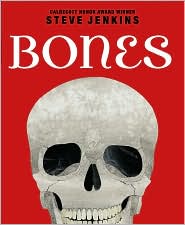
Then one morning, my husband said, "Hey, look at this!" He pointed to a Science book view: BONES. "Looks like you had a good idea."
Yep. Good idea, too late. It was beautifully done by Steve Jenkins. So beautifully done, it won a Caldecott Honor Award. I have been wanting to get my hands on this book ever since, and we finally got a copy last week.
BONES is truly stunning. The illustrations are cut paper but are so realistic they look like photographs. (After teaching general zoology for several years, I've seen my share of animal skeletons up close and personal, and these are extraordinarily life-like.) Some pages show different hands and feet. Others have different animals shown to scale, so it's easy to compare the femur (thigh bone) of an elephant, a human, and a cat. Or the ribs of a human, sloth, turtle and python (all 200 of them).
The text explains, in clear language, the various jobs of bones, from support and movement (via joints) to making blood cells.
It is exactly the book I wanted to write, illustrated in a manner I could never have done. And I am thrilled to add it to our collection. If your kids get Scholastic book club orders, look for it there in paperback. You'll learn a lot and love the illustrations, too!
Have you ever had an idea only to discover it had already been done?
For example, A bat's wings are membranes stretched between their incredibly long finger bones. A whale's flipper has the same bones but much shorter, stouter, and crowded together. They have the same single upper-arm bone, two forearm bones, set of rock-like wrist bones, and elongated hand/finger bones that we do. They have simply been modified through time to suit their particular use.
Then one morning, my husband said, "Hey, look at this!" He pointed to a Science book view: BONES. "Looks like you had a good idea."
| source |
Yep. Good idea, too late. It was beautifully done by Steve Jenkins. So beautifully done, it won a Caldecott Honor Award. I have been wanting to get my hands on this book ever since, and we finally got a copy last week.
BONES is truly stunning. The illustrations are cut paper but are so realistic they look like photographs. (After teaching general zoology for several years, I've seen my share of animal skeletons up close and personal, and these are extraordinarily life-like.) Some pages show different hands and feet. Others have different animals shown to scale, so it's easy to compare the femur (thigh bone) of an elephant, a human, and a cat. Or the ribs of a human, sloth, turtle and python (all 200 of them).
The text explains, in clear language, the various jobs of bones, from support and movement (via joints) to making blood cells.
It is exactly the book I wanted to write, illustrated in a manner I could never have done. And I am thrilled to add it to our collection. If your kids get Scholastic book club orders, look for it there in paperback. You'll learn a lot and love the illustrations, too!
Have you ever had an idea only to discover it had already been done?
Labels:
children's books,
non-fiction,
picture books,
science
Friday, September 23, 2011
Doing it right
On Monday, I wrote about Livia Blackburne's thoughts about blogging to reach your audience. Her post dovetailed with a brief social media session Mitali Perkins held at Chautauqua. Mitali's had me thinking ever since. Specifically, I've been wondering about this:
How can you contribute to children's writing in a way that sets you apart?
Lots of writers blog about writing. It helps us to connect with other writers, and perhaps to the intended audience. But if someone has the option to follow what a well-known, established author writes versus someone just starting out, which would they choose? As writers, we need to create our niche in the blogosphere.
Mitali suggests brainstorming (free write in a journal) what you want to contribute. Ideally, you do this before you even begin your blog, but you can always modify your content as you go.
Blog about things that serve kids and parents. What are you passionate about? Are there topics that come up again and again in your writing? Themes that weave through your work? Blog about those kinds of topics. Discuss related children's books or activities; provide them with resources.
Mitali does this at Mitali's Fire Escape: a safe place to chat about books between cultures. She blogs about writing, but she also writes posts about the issues that appear in her books. She provides resources for readers, so they can find out more about a topic or even find a way to help. These posts are for kids, parents, and teachers - the audience.
Me? I'm passionate about science, nature, and grappling with complex problems that don't have a black and white solution. It's important to me that everyone see both sides of an issue (which happens all too seldom these days). All of those things come up in my writing. To reach my intended audience, Mitali said I should blog about other nonfiction books, fiction books that cover similar kinds of topics, and science-y activities that kids and parents can do together; things they can do to make a difference.
How do you let your intended audience know about your posts? Send out provocative twitter posts that link to the blog post, and reach out to the audience you want to reach. Mitali has lists of people involved in the issues she writes about. Find your audience. Let them know you're there. Give them a reason to stop by.
For me, that means you will be seeing new kinds of posts. Posts about terrific books, posts about important subjects, posts about things kids (and teachers and parents) can do to get involved. I will also write a bit about writing (there's still lots to share from Chautauqua), but that won't be all I blog about.
How will you change the way you blog?
How can you contribute to children's writing in a way that sets you apart?
Lots of writers blog about writing. It helps us to connect with other writers, and perhaps to the intended audience. But if someone has the option to follow what a well-known, established author writes versus someone just starting out, which would they choose? As writers, we need to create our niche in the blogosphere.
Mitali suggests brainstorming (free write in a journal) what you want to contribute. Ideally, you do this before you even begin your blog, but you can always modify your content as you go.
Blog about things that serve kids and parents. What are you passionate about? Are there topics that come up again and again in your writing? Themes that weave through your work? Blog about those kinds of topics. Discuss related children's books or activities; provide them with resources.
Mitali does this at Mitali's Fire Escape: a safe place to chat about books between cultures. She blogs about writing, but she also writes posts about the issues that appear in her books. She provides resources for readers, so they can find out more about a topic or even find a way to help. These posts are for kids, parents, and teachers - the audience.
Me? I'm passionate about science, nature, and grappling with complex problems that don't have a black and white solution. It's important to me that everyone see both sides of an issue (which happens all too seldom these days). All of those things come up in my writing. To reach my intended audience, Mitali said I should blog about other nonfiction books, fiction books that cover similar kinds of topics, and science-y activities that kids and parents can do together; things they can do to make a difference.
How do you let your intended audience know about your posts? Send out provocative twitter posts that link to the blog post, and reach out to the audience you want to reach. Mitali has lists of people involved in the issues she writes about. Find your audience. Let them know you're there. Give them a reason to stop by.
For me, that means you will be seeing new kinds of posts. Posts about terrific books, posts about important subjects, posts about things kids (and teachers and parents) can do to get involved. I will also write a bit about writing (there's still lots to share from Chautauqua), but that won't be all I blog about.
How will you change the way you blog?
Labels:
author,
balance,
change,
Chautauqua,
children's books,
platform,
social networks,
twitter
Wednesday, September 14, 2011
Hooking teachers and librarians
One of the terrific things about Chautauqua was having a chance to meet with lots of teachers and librarians (on the faculty and among the attendees) and hear what they look for when they select trade books for the classroom and library.
Guess what? It's not just about content. (Obviously that's important, but content alone won't do it.)
Most teachers at the elementary level choose books that complement their curriculum. Fiction or non, the books need to dovetail in some way with the concepts that are being taught. And if the books connect different areas? Even better. (Think multicultural issues and geography, for example.)
How do you know whether your book will complement the curriculum? Do a google search for "state curriculum standards." Start with your state, then check out others. How do they compare? Can you make a case in your query/cover letter that your book could be used by schools in a number of states?
How books are written is also important: books that assume background knowledge kids don't have will NOT be used in the classroom. Background needs to be built into the text, so the readers can understand without having to fetch a dictionary.
Illustrations? They're terrific! But they need to appear on the same page spread as the relevant text. If the reader has to flip a page (or two) to find the illustrations, teachers will skip the book. Make the information easily accessible to your readers. Ask to see page proofs and make it clear that you want a layout that enhances readability and retention of information.
Teachers and librarians also need to teach study skills. How? By choosing books that have a table of contents, a glossary, an index, and a list of additional resources. List of possible discussion questions? Bring 'em on! Anything to make a teacher's life easier will be greatly appreciated.
If your book would work well in the classroom, be sure to mention how it addresses these kinds of things in your query letter. Many schools use the SQ3R reading method. Describe how your book can be used in this way. Not only will you impress the editor reading your submission, you vastly increase the chances of getting your books into schools and libraries.
What is your favorite book that was/is used in the classroom? Why?
Guess what? It's not just about content. (Obviously that's important, but content alone won't do it.)
| source |
Most teachers at the elementary level choose books that complement their curriculum. Fiction or non, the books need to dovetail in some way with the concepts that are being taught. And if the books connect different areas? Even better. (Think multicultural issues and geography, for example.)
How do you know whether your book will complement the curriculum? Do a google search for "state curriculum standards." Start with your state, then check out others. How do they compare? Can you make a case in your query/cover letter that your book could be used by schools in a number of states?
How books are written is also important: books that assume background knowledge kids don't have will NOT be used in the classroom. Background needs to be built into the text, so the readers can understand without having to fetch a dictionary.
Illustrations? They're terrific! But they need to appear on the same page spread as the relevant text. If the reader has to flip a page (or two) to find the illustrations, teachers will skip the book. Make the information easily accessible to your readers. Ask to see page proofs and make it clear that you want a layout that enhances readability and retention of information.
Teachers and librarians also need to teach study skills. How? By choosing books that have a table of contents, a glossary, an index, and a list of additional resources. List of possible discussion questions? Bring 'em on! Anything to make a teacher's life easier will be greatly appreciated.
If your book would work well in the classroom, be sure to mention how it addresses these kinds of things in your query letter. Many schools use the SQ3R reading method. Describe how your book can be used in this way. Not only will you impress the editor reading your submission, you vastly increase the chances of getting your books into schools and libraries.
What is your favorite book that was/is used in the classroom? Why?
Labels:
Chautauqua,
children's books,
education,
fiction,
learning,
non-fiction,
publishing,
writing
Monday, September 12, 2011
Resonance
Have you ever finished a book and felt that the end somehow wrapped up the entire story in a way you couldn't quite put your finger on? Something subtle? Chances are, the author created an ending that resonated with the beginning.
The same is true of magazine stories (fiction) and articles (non-fiction); in fact, the resonance is often more noticeable in a thousand words or less. It's that clever ending that returns to the premise from the opening paragraph. Pick up an issue of Highlights magazine, and you'll see what I mean.
It turns out, that resonance is intentional. It is one of the things editors look for in the articles and stories they evaluate. If you write for Highlights or other children's magazines, check for this before you submit.
Resonance isn't just for short pieces of work. Sara Grant, author of the recently released Dark Parties, incorporated resonance into her novel and recommends that other authors do the same. This isn't the answer to the big question posed on page one, rather something quiet... something that provides emotional satisfaction for the reader. It brings the work full circle.
What examples of resonance have you seen lately?
The same is true of magazine stories (fiction) and articles (non-fiction); in fact, the resonance is often more noticeable in a thousand words or less. It's that clever ending that returns to the premise from the opening paragraph. Pick up an issue of Highlights magazine, and you'll see what I mean.
It turns out, that resonance is intentional. It is one of the things editors look for in the articles and stories they evaluate. If you write for Highlights or other children's magazines, check for this before you submit.
Resonance isn't just for short pieces of work. Sara Grant, author of the recently released Dark Parties, incorporated resonance into her novel and recommends that other authors do the same. This isn't the answer to the big question posed on page one, rather something quiet... something that provides emotional satisfaction for the reader. It brings the work full circle.
What examples of resonance have you seen lately?
Labels:
children's books,
fiction,
magazines,
non-fiction,
writing
Wednesday, September 7, 2011
Chautauqua notes
I'm back! My apologies for the longer-than-expected hiatus. The move took much more out of me than I'd anticipated, but yesterday the movers took the boxes away, and I promised myself I'd get back to blogging. So here I am.
First, thanks to Christie Wright Wild for the Pot-o-gold award! I am honored that you find this blog full of interesting and helpful content. :)
And I know you're all dying to hear about the writers workshop... Chautauqua was fantastic! If you have an opportunity, I highly recommend it. The faculty were fully engaged with the attendees, and the staff maximized the number of opportunities we had available to speak with them. I'm delighted to say that I've made real friends with some of the faculty members (and many attendees), and I'm not sure you can say that about many other conferences.
Most of the week had workshops; three concurrent sessions at a time. There's something for everyone, from writers of picture books and early readers to MG and YA; from fiction to non. If, like me, you write in more than one genre, it was nearly impossible to decide which sessions to attend, and they were all incredibly informative.
In addition to the scheduled sessions, faculty held "lunch and learns" - informal meet-ups during the lunch break during which the faculty would talk about a particular topic. Use of social media? Spend the lunch hour with Mitali Perkins. Classroom presentations? Hang out with Sneed B. Collard, III. What does a 9 3/4 year-old want in a book, anyway? Harold Underdown and his daughter are there to give you some insight. I learned just as much from these lunches as I did from the official curriculum.
But probably the best part of the Chautauqua experience is the one-on-one mentorship. Each attendee submits a piece of work (first ten pages of a novel, PB manuscript, or magazine article), and they are paired with a faculty reader/mentor to work on it. You get two meetings with your mentor, so you have time to make changes and look at revisions. I was paired with Andy Boyles for one of my nonfiction PB manuscripts, and he offered some terrific advice for improving it.
And did I mention the food? Or the enormous bag of books that you bring home with you? The delightful attendees? The superheroic ability of Jo Lloyd, coordinator for the Highlights Foundation, to leap tall buildings and not get flustered in the face of things like two-day power outages? The gorgeous setting in the Chautauqua Institution? It was truly an extraordinary experience.
Want to attend? I know you do. :) Yes, it's a pricey venture, but the Highlights Foundation offers scholarships that make it reasonable. I hope to see you there in future years!
And if you're too impatient to wait until next year, check out the Founders Workshops. (Some of these are next on my list.)
So... that's what I've been doing. What have you all been up to while I've been away?
First, thanks to Christie Wright Wild for the Pot-o-gold award! I am honored that you find this blog full of interesting and helpful content. :)
And I know you're all dying to hear about the writers workshop... Chautauqua was fantastic! If you have an opportunity, I highly recommend it. The faculty were fully engaged with the attendees, and the staff maximized the number of opportunities we had available to speak with them. I'm delighted to say that I've made real friends with some of the faculty members (and many attendees), and I'm not sure you can say that about many other conferences.
Most of the week had workshops; three concurrent sessions at a time. There's something for everyone, from writers of picture books and early readers to MG and YA; from fiction to non. If, like me, you write in more than one genre, it was nearly impossible to decide which sessions to attend, and they were all incredibly informative.
In addition to the scheduled sessions, faculty held "lunch and learns" - informal meet-ups during the lunch break during which the faculty would talk about a particular topic. Use of social media? Spend the lunch hour with Mitali Perkins. Classroom presentations? Hang out with Sneed B. Collard, III. What does a 9 3/4 year-old want in a book, anyway? Harold Underdown and his daughter are there to give you some insight. I learned just as much from these lunches as I did from the official curriculum.
But probably the best part of the Chautauqua experience is the one-on-one mentorship. Each attendee submits a piece of work (first ten pages of a novel, PB manuscript, or magazine article), and they are paired with a faculty reader/mentor to work on it. You get two meetings with your mentor, so you have time to make changes and look at revisions. I was paired with Andy Boyles for one of my nonfiction PB manuscripts, and he offered some terrific advice for improving it.
And did I mention the food? Or the enormous bag of books that you bring home with you? The delightful attendees? The superheroic ability of Jo Lloyd, coordinator for the Highlights Foundation, to leap tall buildings and not get flustered in the face of things like two-day power outages? The gorgeous setting in the Chautauqua Institution? It was truly an extraordinary experience.
Want to attend? I know you do. :) Yes, it's a pricey venture, but the Highlights Foundation offers scholarships that make it reasonable. I hope to see you there in future years!
And if you're too impatient to wait until next year, check out the Founders Workshops. (Some of these are next on my list.)
So... that's what I've been doing. What have you all been up to while I've been away?
Labels:
awards,
Chautauqua,
children's books,
fiction,
gratitude,
learning,
magazines,
middle grade,
networking,
non-fiction,
picture books,
writer's conference
Friday, March 18, 2011
Foresight
A few years ago, in my online Ecological Issues course, I had a student who took me by surprise. We were discussing various energy alternatives, and I was trying to give them a balanced view (each and every option has benefits and drawbacks; there is no panacea). This student ranted against nuclear power. In each and every post, he was vehemently against it.
Now such strong opposition to something is unusual in college students (in my experience). I usually find myself trying to pull them out of a state of apathy. Keep in mind, the class was online, and I had never met my students. So it wasn't until this particular student turned in his final paper at the end of the semester that I understood.
He was from Japan. He was vehemently anti-nuclear because of the earthquakes there. What if, he argued, there was a big one? What would happen to the reactors?
And now we watch, hoping the emergency teams may somehow manage to prevent a complete meltdown. People who survived first the earthquake and then the tsunami are now at risk of high doses of radiation. A slow, painful, alternative. Talk about foresight.
You may have heard, but Rachael Harrie, Marieke, Luna, Tessa Quin, and Amanda Milner have started Write Hope, a charity auction to support relief efforts in Japan.
If you have something to donate: ARCs, critiques, or anything else kidlit, please donate!
And if you don't, please participate in the auction. All proceeds will be donated to the Save the Children emergency relief fund for Japan.
Now such strong opposition to something is unusual in college students (in my experience). I usually find myself trying to pull them out of a state of apathy. Keep in mind, the class was online, and I had never met my students. So it wasn't until this particular student turned in his final paper at the end of the semester that I understood.
He was from Japan. He was vehemently anti-nuclear because of the earthquakes there. What if, he argued, there was a big one? What would happen to the reactors?
And now we watch, hoping the emergency teams may somehow manage to prevent a complete meltdown. People who survived first the earthquake and then the tsunami are now at risk of high doses of radiation. A slow, painful, alternative. Talk about foresight.
You may have heard, but Rachael Harrie, Marieke, Luna, Tessa Quin, and Amanda Milner have started Write Hope, a charity auction to support relief efforts in Japan.
![]() |
| Write Hope's mascot Nozomi |
If you have something to donate: ARCs, critiques, or anything else kidlit, please donate!
And if you don't, please participate in the auction. All proceeds will be donated to the Save the Children emergency relief fund for Japan.
Labels:
children's books,
compassion,
Write Hope
Monday, February 21, 2011
Marketing Monday - Carole Anne Carr

Today I would like to welcome Carole Anne Carr, a children's author who has self published several books for children, including two novels and a picture book. She will also have fantasy based on Norse mythology available soon.
Many of you already know Carole from her blog; she writes historical fiction set near her home in England. Through her books, she is making a tour of Shropshire's historical sites, which must be a wonderful experience for local children.
What has the process of self-publishing been like for you?
Very hard work indeed. I began this process as I started serious writing very late in life and didn't think any publisher would be interested in me at my age.
First I tried to discover whether I was on the right track by completing a part time three year course on creative writing. When I did well, I then decided to go ahead with this project.
Then I had to work out how to be a self-publisher. I didn't want vanity publishing, or a pay on demand printer, so I set about finding a good printer whose work I liked and who would publish one hundred books at a time - a number I thought I could sell to begin with.
I then used Google to discover how to be a publisher, learned how to make print ready files, asked my Grandson how to design a book cover and also make it into a print ready file, and learned about ISBN numbers and how to attach them to the cover. From the printer I learned about types of paper, how my book would be bound, costs,how long the process would take. I visited the printer to see the whole process from start to finish.
Then I wanted to add a picture book to my published work and so purchased a simplified version of photoshop - elements 8 - which was the correct one for my needs and struggled to place my illustrations into the book file.
Of course I edited my own work, a long tedious process, found a friend who would act as accountant and helped me set up as self-employed. I have since found someone to help with the editing, dicovered on LinkedIn, who is also at the beginning stage of his career and as yet does not charge.
How has online social networking helped you market your books?
Not a great deal as yet. It leads people to my website and bookshop, but it is only by my author appearances that I later have people buying from the site. However, I have found many useful connections, people who have kindly helped me along the way, through LinkedIn. Moral support that I receive from Blogger, Facebook, Twitter, is always welcome.
What steps have you taken to market your books in person (with bookstores, schools, libraries, etc.)?
I have sold over 1000 books since I started at the beginning of 2010, not a great number, and this has been due to selling myself to independent bookshops, working in local libraries and schools as visiting author, (placing my books in county libraries), visiting schools, (I taught for 25 years) and reading from my books and teaching creative writing.
I have joined many societies, Women in Rural Business and joined them at large county shows, attended craft fairs, I'm a member of the Society of Authors, Jelly, and the National Association of Writers in Schools and attend their conferences. I keep in touch with Nielsen, and have finally been recognised by Gardners the big book distribution people. I also give talks to women's groups.
My books relate to historical sites, although children's fiction, and I have made sure they are for sale in museums and bookshops related to those sites. My next book is fantasy, I'm hoping to widen my apppeal. I am constantly working to improve my visibility whilst writing more books. My first two books are shortly to become eBooks so that I can reach a wider market. If you google me, you will find that I appear over many many pages, very hard work indeed.
What advice do you have for other children's authors who might be thinking of self-publishing?
It is possible to be successful, and I think with much persistance you can become reasonably well known as an author. If you have the ability, and you can always take courses as I did to make sure you are on the right track, and you have the drive, then I'd say 'go for it'. However, I must add that it is easier for me, being retired!
If you are a published author and you would like to share your experiences with marketing and promoting your book(s), I'd love to share your story! Please contact me at anpstevens [at] gmail [dot] com.
Labels:
author,
children's books,
fiction,
Marketing Monday,
perseverance,
picture books
Subscribe to:
Posts (Atom)