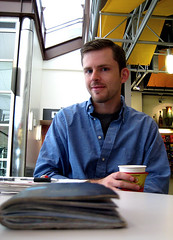
Time for another window of insight. This month, I interviewed the remarkable founder of The Art of Non-Conformity, Chris Guillebeau. Chris lives an "unconventional life" and dedicates his life to helping others do the same. So how does the creative process inform his work? Read on to find out...
1. How do you describe the work that you do?
I’m a writer, traveler, and entrepreneur who helps people live unconventional lives.
2. Did you set out to create guides to living an unconventional life, or did they come about unexpectedly?
It was an organic process. I started writing the AONC blog, and a bunch of people had a bunch of questions. For example, I’m on a quest to visit every country in the world, so naturally I fly a lot. Everyone asked how much I paid for tickets and how I was able to hack the system... so I wrote a guide. The same was true with self-employment and starting a microbusiness.
3. You have given the Unconventional Guides rather extraordinary names (A Brief Guide to World Domination, Build an Empire). What inspired them?
A good name evokes a good story. With World Domination, that is a free manifesto that outlines the way I see the world and how I think people can rise above some common challenges. With Empire Building Kit, the goal is to help people build a business in one year by doing one thing every day.
4. In a broader sense, what are your primary sources of inspiration? (for your work, travels, life)
I lived in West Africa for four years as a volunteer for a medical charity, and think often of the people that are still serving there while I’m traveling the world and drinking coffee. I’m also inspired by my readers — they have helped the project become much more significant than it initially was.
5. Can you describe how the creative process works for you? How does it contribute to your business? To your life?
I try to establish creativity as a guiding value. It’s like healthy eating or exercise — once you establish good lifestyle patterns, you can fall out of them for a day or two and it’s OK. But beyond that, you’re going to feel bad and begin craving the healthy lifestyle again. So the same is true with creativity — every day I think, what am I going to deliver today? What will be different at the end of the day compared to the beginning? And so on — it’s a good kind of addiction, I think.
6. What is the most challenging part of the creative (entrepreneurial) process for you?
Avoiding distractions. Wait, what was that again...?
7. What is the most rewarding part of the creative process?
1) Completing something, even something small — it’s always nice to get something out the door.
2) Hearing from readers about how something I’ve done has affected their lives in a positive way. It’s hard to beat that!
8. At what point do you feel that you have succeeded with a creative endeavor?
Well, I don’t like to rest on success — I think it’s important to always keep looking ahead to the next thing. So when I’m done with an endeavor, I’m already thinking about the next one. But having said that, what I mentioned above about getting good feedback from readers or customers — that definitely has an element of success to it.
9. Anything else you would like to add?
Thanks so much for featuring AONC! I’m grateful and appreciative.
###
My pleasure, Chris. Thanks for providing so many people with so much inspiration.
Showing posts with label Windows of Insight. Show all posts
Wednesday, August 18, 2010
Window of Insight #4: Chris Guillebeau
Wednesday, July 21, 2010
Window of Insight #3: Maureen Crisp
Last week, I mentioned the FaBo collaborative storytelling project created by a collection of New Zealand authors. Today it goes live, and to celebrate, I have some insight into the creative process of one of the authors, Maureen Crisp. Maureen's book Bones, is a story about twins who must solve the mystery of the human bones their dog buries in their garden.1. What got you interested in writing Bones? What other kinds of stories do you write?
I have always had a quirky mind. Short little scenes play themselves out in my mind. One day in my mind popped a dog carrying a large bone. He trotted through my mind and disappeared. I asked myself what kind of bone was that...and the answer Human popped in.
Well I had to write the story to find out all about it. Sometimes ideas can be shelved or forgotten, sometimes you know that if you don’t tease them out they will give you nightmares or nag at you. Bones was one of those. I didn’t want any nightmares. (lol)
I started writing 50 word readers to teach myself to write. They are the hardest to write because you have limited vocabulary and you need to make them funny. Then I started writing short plays so I could learn dialogue. Then I began to write longer pieces. Bones was originally 6000 words. It went to 10,000 for a competition then I had to rip 4000 words out before it was accepted for publication.
2. How does the creative process fit into your work?
Starter ideas pop in at any time. However when I’m in the middle of a project I find that if I can get a period of sustained quiet I can get back into the project and put myself into the scene and then I find out what happens next. The same thing happens in teaching, I need a period of quiet to plan what I am going to do...then into the craziness of teaching and learning with big bunches of children we go...
3. Where do you find sources of inspiration?
I am always imagining the next scene in my mind in anything I witness as I go through my daily life...sometimes they are cartoonish happenings...sometimes they are dialogue tags...I eves drop and file away ideas and situations in my mind. I find these come back to me when I am in the middle of a sustained period of writing.
4. What role do you feel that creativity plays in your life (teaching, parenting)?
I find it a release. It acts as a weather vein for my mental well being. I find that if I am feeling low I can’t get myself motivated to sit down and write. When I am working with children I borrow their creative energy using it in a theatrical way which then feeds back to them. This means that in our house occasionally there is silliness on the part of the mother...every day you must laugh...it is good for the soul. So I do my part to make sure that there are opportunities for my children to laugh.
5. What is the most challenging part of the creative process for you?
Sitting down and concentrating. I have to force myself some days to block out distractions.
Some days there are just too many distractions...I have heard from writer friends that the letting yourself be distracted means that you aren’t ready to write the scene... Of course that is a great excuse for procrastination...My inner self just says lazy lazy lazy....
6. What is the most rewarding part of the creative process?
There are two answers I think to this question. Putting in the effort and knowing that you have done a good job on the project. This gives a personal feeling of satisfaction an ‘all’s right with world.’ The second answer is when someone else not connected with the project turns around and says “by the way you did a great job on xyz.’ That sets you up to walk on air; especially if they are children... it’s like winning a lottery.
7. At what point do you feel that you have succeeded with a creative endeavour?
When I am still happy with what I have written after three months of not working on it at all. If I find myself wanting to change things, after putting it aside to clear my head, I know that I need to work harder on what I am doing.
8. Anything else you would like to add?
At the moment a team of us are writing a fiction book, each of us taking a chapter each. We don’t know where the story will go, we don’t know what will happen next until we get to our own chapter, where we can do what we like in solitude, then add it to book. The collaboration has sparked amazing ideas and a feeling of flying high on the creativity scale. The group are laughing and joking and feeding lines backwards and forwards as we write the story. This is unlike our usual work habit but it is highly stimulating and we are all relishing the freedom of not worrying about the big picture...time will tell if the work we are doing is any good...it is fun though, combining the best of both solitude and collaboration.
This questionnaire has had me thinking about my own process of creativity throughout the month. Thanks for the opportunity to participate.
Maureen
My pleasure, Maureen. Thanks for taking the time to give us such wonderful insight. I can't wait to see how the FaBo Story unfolds.
If you are interested in following the story, check it out at http://www.fabostory.blogspot.com/.
Monday, June 28, 2010
Window of Insight #2: Michael Grant
This window of insight focuses on a non-writer, and, by many accounts, a non-creative (but don't be fooled). Michael Grant is a computational mathematics researcher who focuses on the concept of optimization, which he applies to a variety of topics. Here's what makes Michael creative (all answers are copyright Michael Grant).
1. Please describe the kind of work that you do.
My degrees claim that I am an electrical engineer. But over the course of my college work, I discovered that I was more interested in the computational and mathematical details than in the specific engineering applications.
For my doctoral work, I focused on the field of optimization: the mathematics behind selecting the best choice among a family of alternatives. Whether the challenge is to find the highest performance, the lowest cost, the most efficient use of resources, or the lowest risk—any time the notion of “best” can be expressed mathematically—optimization is the method. Not surprisingly, optimization has applications in a wide variety of fields, including engineering (of course), the applied sciences, business, and finance.
My work these days takes several forms. I teach a graduate-level course in optimization at the local university, and I give seminars and lectures in academic and corporate settings. I develop and maintain software that is used by a variety of researchers around the world that makes it easier for them to use optimization in their work. And I apply optimization and related concepts to a variety of engineering problems.
2. How does the creative process fit into your work?
I think it is fair to say that people typically associate creativity with, well, the creative and aesthetic arts: music and dance, visual arts, fictional writing, and so forth.
But at its most basic, creativity is simply the act of generating concepts and works that are new and original (at least to their creator). And in that sense, it is clear that creativity can be found in many technical fields as well, and engineering in particular. Any time I am developing the first solution to a new problem, or a new and better solution to an old problem, I am being creative.
Constructing a new piece of software certainly can a creative act, depending upon how much latitude the programmer is being given to accomplish it. But in the case of my most popular software, CVX, I created not just some new code but also a new methodology: a new way of thinking about or approaching the problems it is designed to solve. So there was creativity involved not just in its construction, but in its very conception.
Creativity enters into the teaching and communication as well. Every student or audience member approaches the material with a different background, so I must often invent new ways to explain or demonstrate particular concepts.
3. Where do you find sources of inspiration?
I try to keep up with the latest developments in my field by reading a lot of papers and speaking with colleagues. I typically have a number of problems percolating in the back of my mind, each stuck in limbo waiting for the right new idea or concept to come along that enables me to solve them. I would love to say that I always invent that critical missing piece on my own. But frequently, perhaps more often than not, I will find it in other people’s work and adapt it to my purposes.
4. What role do you feel that creativity plays in your life (in your work and beyond)?
I think I’ve addressed how creativity is involved in my work. But of course I think creativity is useful and even essential in a vibrant life outside of work as well.
Certainly, family life benefits tremendously from creativity. My wife is probably better about this than I am, but we both strive to find creative new ways to teach our daughter new ideas and behaviors. I’d like to think I apply creativity in how I treat with my wife as well; at the very least, we can agree that it would be nice if it were true. :)
One interesting outlet for creativity I’ve enjoyed lately is my work at church. I volunteer one or two Sundays a month to work on the light board, a bank of levers and buttons that control the house lights, spot lights, and decorative stage lights. As with many contemporary church settings, the feel is at times reminiscent of a concert! Along with the objective technical aspects like making sure that the singer or pastor is adequately lit, I have the opportunity to be creative in the selection the colors and patterns to follow the mood of the service.
5. What is the most challenging part of the creative process for you?
I often find it hard to finish a project and send it out to be consumed, used, and critiqued. I’m always finding something I can improve, tweak, rework, re-cast… Of course, what good is a creation that cannot be shared? My challenge is to set aside that urge to perfect and just get the work out there. It seems to me that this challenge would be more intense with the creative arts, because once a work is out there it often cannot be revised. In my case, I frequently have the opportunity to improve upon my work after people have had the chance to try it out. It is good for me to remember that.
6. What is the most rewarding part of the creative process?
Certainly, the accolades and encouraging words of others are among the most important rewards. But more than these are the implicit accolades that come when people use my work to further their own, citing my software or papers in theirs. I recently had someone incorporate the use my software into a textbook. I think that means I am immortal! :)
The “Eureka!” moments that come when I make a new discovery or solve a particularly vexing problem are intensely rewarding as well, and I’d say that they are the reasons I love to do research versus straight-ahead development.
7. At what point do you feel that you have succeeded with a creative endeavor?
I think it is when the external rewards come in that I discussed in the previous question. I certainly acknowledge that a personal satisfaction in the quality of my work is important. But truthfully, the very purpose of my core work is to enable others to solve problems that they would have been unwilling or unable to do without it. So without the positive feedback from others, I could not be certain I had succeeded.
* * *
Thanks, Michael, for the insight. As for immortality, that's Creativity with a capital C: what a lot of creatives secretly crave. ;-)
1. Please describe the kind of work that you do.
My degrees claim that I am an electrical engineer. But over the course of my college work, I discovered that I was more interested in the computational and mathematical details than in the specific engineering applications.
For my doctoral work, I focused on the field of optimization: the mathematics behind selecting the best choice among a family of alternatives. Whether the challenge is to find the highest performance, the lowest cost, the most efficient use of resources, or the lowest risk—any time the notion of “best” can be expressed mathematically—optimization is the method. Not surprisingly, optimization has applications in a wide variety of fields, including engineering (of course), the applied sciences, business, and finance.
My work these days takes several forms. I teach a graduate-level course in optimization at the local university, and I give seminars and lectures in academic and corporate settings. I develop and maintain software that is used by a variety of researchers around the world that makes it easier for them to use optimization in their work. And I apply optimization and related concepts to a variety of engineering problems.
2. How does the creative process fit into your work?
I think it is fair to say that people typically associate creativity with, well, the creative and aesthetic arts: music and dance, visual arts, fictional writing, and so forth.
But at its most basic, creativity is simply the act of generating concepts and works that are new and original (at least to their creator). And in that sense, it is clear that creativity can be found in many technical fields as well, and engineering in particular. Any time I am developing the first solution to a new problem, or a new and better solution to an old problem, I am being creative.
Constructing a new piece of software certainly can a creative act, depending upon how much latitude the programmer is being given to accomplish it. But in the case of my most popular software, CVX, I created not just some new code but also a new methodology: a new way of thinking about or approaching the problems it is designed to solve. So there was creativity involved not just in its construction, but in its very conception.
Creativity enters into the teaching and communication as well. Every student or audience member approaches the material with a different background, so I must often invent new ways to explain or demonstrate particular concepts.
3. Where do you find sources of inspiration?
I try to keep up with the latest developments in my field by reading a lot of papers and speaking with colleagues. I typically have a number of problems percolating in the back of my mind, each stuck in limbo waiting for the right new idea or concept to come along that enables me to solve them. I would love to say that I always invent that critical missing piece on my own. But frequently, perhaps more often than not, I will find it in other people’s work and adapt it to my purposes.
4. What role do you feel that creativity plays in your life (in your work and beyond)?
I think I’ve addressed how creativity is involved in my work. But of course I think creativity is useful and even essential in a vibrant life outside of work as well.
Certainly, family life benefits tremendously from creativity. My wife is probably better about this than I am, but we both strive to find creative new ways to teach our daughter new ideas and behaviors. I’d like to think I apply creativity in how I treat with my wife as well; at the very least, we can agree that it would be nice if it were true. :)
One interesting outlet for creativity I’ve enjoyed lately is my work at church. I volunteer one or two Sundays a month to work on the light board, a bank of levers and buttons that control the house lights, spot lights, and decorative stage lights. As with many contemporary church settings, the feel is at times reminiscent of a concert! Along with the objective technical aspects like making sure that the singer or pastor is adequately lit, I have the opportunity to be creative in the selection the colors and patterns to follow the mood of the service.
5. What is the most challenging part of the creative process for you?
I often find it hard to finish a project and send it out to be consumed, used, and critiqued. I’m always finding something I can improve, tweak, rework, re-cast… Of course, what good is a creation that cannot be shared? My challenge is to set aside that urge to perfect and just get the work out there. It seems to me that this challenge would be more intense with the creative arts, because once a work is out there it often cannot be revised. In my case, I frequently have the opportunity to improve upon my work after people have had the chance to try it out. It is good for me to remember that.
6. What is the most rewarding part of the creative process?
Certainly, the accolades and encouraging words of others are among the most important rewards. But more than these are the implicit accolades that come when people use my work to further their own, citing my software or papers in theirs. I recently had someone incorporate the use my software into a textbook. I think that means I am immortal! :)
The “Eureka!” moments that come when I make a new discovery or solve a particularly vexing problem are intensely rewarding as well, and I’d say that they are the reasons I love to do research versus straight-ahead development.
7. At what point do you feel that you have succeeded with a creative endeavor?
I think it is when the external rewards come in that I discussed in the previous question. I certainly acknowledge that a personal satisfaction in the quality of my work is important. But truthfully, the very purpose of my core work is to enable others to solve problems that they would have been unwilling or unable to do without it. So without the positive feedback from others, I could not be certain I had succeeded.
* * *
Thanks, Michael, for the insight. As for immortality, that's Creativity with a capital C: what a lot of creatives secretly crave. ;-)
Wednesday, June 2, 2010
Window of Insight #1: Evelyn B. Christensen
Creativity is such a personal process; it works differently for everyone, and people use it in a wide variety of situations (it is NOT exclusively relegated to the artists and writers of the world). I pondered this for a while, then thought, Who better to provide insight into their personal creative process than a creative? Herewith, I present you with the first Windows of Insight interview. *bows with a flourish*
Evelyn B. Christensen is the author of a variety of educational puzzle books. Ev was the first person to respond to my very first post at the CBI Clubhouse, and she was also the first to respond to my request for an interview (Ev is clearly much more on top of things than I). And I am honored to begin the WoI series with her. (Please note that all responses below are copyright Evelyn B. Christensen.)
What got you interested in creating puzzles and games?
Puzzles and games were a big part of my childhood. I have five siblings and grew up in a small town in eastern Kentucky where the kind of extra-curricular activities that fill most children’s schedules these days were practically non-existent. That left plenty of time for games and puzzles.
My father had also spent two years of college studying to be an aeronautical engineer before he decided to become a minister. That engineer’s mind of his didn’t disappear, and he was good at challenging us kids to wonder about the hows and whys and puzzles of all kinds of things. And Mom was the wordsmith. She taught Latin and I still remember some of the Latin riddle-puns from her class.
So puzzles and games were ‘in my blood’ from my childhood. Then in college I decided to major in math. A good math problem, by its very nature, is a kind of puzzle, so my higher level academic training reinforced my interest in puzzles.
How does the creative process fit into your work?
The creative process comes into play in a variety of stages of my work. Sometimes it’s active when I’m coming up with the basic puzzle design. Examples of that are my first book Clip Clue Puzzles and my book Subtraction Secrets.
But sometimes my publisher tells me they want a certain type of puzzle book, and then the creativity is in making the book something unique within the framework of that kind of puzzle. Examples of that are my Venn diagram books. I didn’t create the concept of Venn diagrams, but when I came up with basing all the puzzles in one book on nursery rhymes, basing the puzzles in another on stories about a kid and his interactions with friendly aliens, and basing another one on the fifty states, that was the creative process coming into play.
Then, of course, designing the individual puzzles involves creativity. I had great fun deciding how to turn each of those nursery rhymes into a puzzle. A lot of times in designing individual puzzles I also draw on my creativity when I figure out how to state clues. You have to communicate a certain amount of information in clues, but how you state it can make the difference between a challenging, fun puzzle and a boring puzzle.
For a simple example, compare these two clues: “Ev’s age is 6” and “Ev’s age is the lowest even number between 4 and 10.” Coming up with interesting ways to say the same thing takes creativity.
Where do you find sources of inspiration?
Depending on your spiritual outlook, you may not like my response to this question. But the truth, for me, is that my source of inspiration is very much God. When I have a creative idea, I feel strongly that it’s a gift from God. The God I believe in is a Creator God. We humans are made in his image, and some of our most satisfying, joyous moments are when we are participating in the creative process. Using my creativity puts me, that creative part of me that is in his image, in tune with God in a very special way.
What role do you feel that creativity plays in your life (in your work and beyond)?
This is a hard question, because creativity is intrinsically bound up in so much of what I do. This was especially true when I was teaching. I am a teacher at heart, even more than I’m a writer. I loved teaching partly because it gave me so many opportunities to use my creativity—planning interesting lessons, developing materials to help kids learn, figuring out the best ways to explain concepts, deciding fun ways for kids to practice skills, writing songs and poems to convey content, and on and on.
The trend toward government-mandated curriculum scares me, because I see it taking away from teachers more and more of the opportunities for them to use their creativity. I’ve talked with wonderful, creative teachers who are very frustrated by the constraints that have been put upon them, and I think we’re going to lose a lot of our most creative teachers. I would not want someone telling me exactly what I have to teach, when I have to teach it, and how I have to teach it. That’s too much like teaching from a cookbook, and where’s the creativity in that (or for a creative person, the fun)?
What is the most challenging part of the creative process for you?
Ummm…keeping it under control? Seriously. Creativity gives me the ability to see multiple, unintended uses for almost any object. It’s my curse. It means it’s hard for me to throw anything away. Normal people can get rid of an object when its intended use no longer serves them, but since I can easily see at least five other uses for it, do you think I still have it? Of course! Along with the 6,957,184 other things in our car-less, 2-car garage.
[lol! I can relate to this, but we have a serious shortage of storage space, so the tops of the closets are covered with things I've saved, they're stuffed in what little extra cabinet and drawer space I can find. And sometimes I have to sort through the discard the things that haven't been reused to make way for the new. Makes for a messy household.]
What is the most rewarding part of the creative process?
It’s definitely a rewarding feeling, very satisfying, when I realize I have a great idea—at whatever stage I’m at in the puzzling process. Writing puzzle books can sometimes include parts that aren’t very creative. For example, I might have an idea for fun math puzzles that produce a picture as their end product (like my Multiplication Mosaics). Coming up with the initial idea and developing the pictures is creative, and therefore fun. But coming up with the math problems to go with the pictures is not creative, and therefore often simply tedious. So definitely, the most rewarding part is generating the new ideas.
At what point do you feel that you have succeeded with a creative endeavor (e.g., a puzzle or book of puzzles and riddles)?
When I have created a puzzle or a book of puzzles that I know intuitively, in my mind and heart, is a good product—one that will challenge kids or adults to think and stretch their minds in fun ways—then I feel that I have succeeded in my creative endeavor.
Holding the published book in my hands is another level of feeling that success, but even if that never happens I can still feel I’ve succeeded in creating something special. For example, my Aba-Conundrums, puzzles based on the abacus, took seven years to find a publisher. But in spite of all the rejections, during those seven years I still felt I’d created a successful manuscript. (Fat Brain Toy Co. is bringing the book out in June.)
Of course, the ultimate feeling of success for me is having a child or parent or teacher tell me that they love my book. The goal of my creative endeavors is to help make learning fun, so hearing it from the ones I create for is confirmation beyond my own feelings.
~~~~~~~~~~~~~~~~~~~~~~~
Ev's puzzles are wonderful fun for adults and children alike. (My oldest adores the addition and subtraction ones.) Check out a few of them on Ev's author site. And while you're there, check out her books. Then go buy some. Why do Sudoku day after day, when you can do Wordoku or work your brain with a bit of math or a hinky pinky instead?
Evelyn B. Christensen is the author of a variety of educational puzzle books. Ev was the first person to respond to my very first post at the CBI Clubhouse, and she was also the first to respond to my request for an interview (Ev is clearly much more on top of things than I). And I am honored to begin the WoI series with her. (Please note that all responses below are copyright Evelyn B. Christensen.)
What got you interested in creating puzzles and games?
Puzzles and games were a big part of my childhood. I have five siblings and grew up in a small town in eastern Kentucky where the kind of extra-curricular activities that fill most children’s schedules these days were practically non-existent. That left plenty of time for games and puzzles.
My father had also spent two years of college studying to be an aeronautical engineer before he decided to become a minister. That engineer’s mind of his didn’t disappear, and he was good at challenging us kids to wonder about the hows and whys and puzzles of all kinds of things. And Mom was the wordsmith. She taught Latin and I still remember some of the Latin riddle-puns from her class.
So puzzles and games were ‘in my blood’ from my childhood. Then in college I decided to major in math. A good math problem, by its very nature, is a kind of puzzle, so my higher level academic training reinforced my interest in puzzles.
How does the creative process fit into your work?
The creative process comes into play in a variety of stages of my work. Sometimes it’s active when I’m coming up with the basic puzzle design. Examples of that are my first book Clip Clue Puzzles and my book Subtraction Secrets.
But sometimes my publisher tells me they want a certain type of puzzle book, and then the creativity is in making the book something unique within the framework of that kind of puzzle. Examples of that are my Venn diagram books. I didn’t create the concept of Venn diagrams, but when I came up with basing all the puzzles in one book on nursery rhymes, basing the puzzles in another on stories about a kid and his interactions with friendly aliens, and basing another one on the fifty states, that was the creative process coming into play.
Then, of course, designing the individual puzzles involves creativity. I had great fun deciding how to turn each of those nursery rhymes into a puzzle. A lot of times in designing individual puzzles I also draw on my creativity when I figure out how to state clues. You have to communicate a certain amount of information in clues, but how you state it can make the difference between a challenging, fun puzzle and a boring puzzle.
For a simple example, compare these two clues: “Ev’s age is 6” and “Ev’s age is the lowest even number between 4 and 10.” Coming up with interesting ways to say the same thing takes creativity.
Where do you find sources of inspiration?
Depending on your spiritual outlook, you may not like my response to this question. But the truth, for me, is that my source of inspiration is very much God. When I have a creative idea, I feel strongly that it’s a gift from God. The God I believe in is a Creator God. We humans are made in his image, and some of our most satisfying, joyous moments are when we are participating in the creative process. Using my creativity puts me, that creative part of me that is in his image, in tune with God in a very special way.
What role do you feel that creativity plays in your life (in your work and beyond)?
This is a hard question, because creativity is intrinsically bound up in so much of what I do. This was especially true when I was teaching. I am a teacher at heart, even more than I’m a writer. I loved teaching partly because it gave me so many opportunities to use my creativity—planning interesting lessons, developing materials to help kids learn, figuring out the best ways to explain concepts, deciding fun ways for kids to practice skills, writing songs and poems to convey content, and on and on.
The trend toward government-mandated curriculum scares me, because I see it taking away from teachers more and more of the opportunities for them to use their creativity. I’ve talked with wonderful, creative teachers who are very frustrated by the constraints that have been put upon them, and I think we’re going to lose a lot of our most creative teachers. I would not want someone telling me exactly what I have to teach, when I have to teach it, and how I have to teach it. That’s too much like teaching from a cookbook, and where’s the creativity in that (or for a creative person, the fun)?
What is the most challenging part of the creative process for you?
Ummm…keeping it under control? Seriously. Creativity gives me the ability to see multiple, unintended uses for almost any object. It’s my curse. It means it’s hard for me to throw anything away. Normal people can get rid of an object when its intended use no longer serves them, but since I can easily see at least five other uses for it, do you think I still have it? Of course! Along with the 6,957,184 other things in our car-less, 2-car garage.
[lol! I can relate to this, but we have a serious shortage of storage space, so the tops of the closets are covered with things I've saved, they're stuffed in what little extra cabinet and drawer space I can find. And sometimes I have to sort through the discard the things that haven't been reused to make way for the new. Makes for a messy household.]
What is the most rewarding part of the creative process?
It’s definitely a rewarding feeling, very satisfying, when I realize I have a great idea—at whatever stage I’m at in the puzzling process. Writing puzzle books can sometimes include parts that aren’t very creative. For example, I might have an idea for fun math puzzles that produce a picture as their end product (like my Multiplication Mosaics). Coming up with the initial idea and developing the pictures is creative, and therefore fun. But coming up with the math problems to go with the pictures is not creative, and therefore often simply tedious. So definitely, the most rewarding part is generating the new ideas.
At what point do you feel that you have succeeded with a creative endeavor (e.g., a puzzle or book of puzzles and riddles)?
When I have created a puzzle or a book of puzzles that I know intuitively, in my mind and heart, is a good product—one that will challenge kids or adults to think and stretch their minds in fun ways—then I feel that I have succeeded in my creative endeavor.
Holding the published book in my hands is another level of feeling that success, but even if that never happens I can still feel I’ve succeeded in creating something special. For example, my Aba-Conundrums, puzzles based on the abacus, took seven years to find a publisher. But in spite of all the rejections, during those seven years I still felt I’d created a successful manuscript. (Fat Brain Toy Co. is bringing the book out in June.)
Of course, the ultimate feeling of success for me is having a child or parent or teacher tell me that they love my book. The goal of my creative endeavors is to help make learning fun, so hearing it from the ones I create for is confirmation beyond my own feelings.
~~~~~~~~~~~~~~~~~~~~~~~
Ev's puzzles are wonderful fun for adults and children alike. (My oldest adores the addition and subtraction ones.) Check out a few of them on Ev's author site. And while you're there, check out her books. Then go buy some. Why do Sudoku day after day, when you can do Wordoku or work your brain with a bit of math or a hinky pinky instead?
Subscribe to:
Comments (Atom)
